
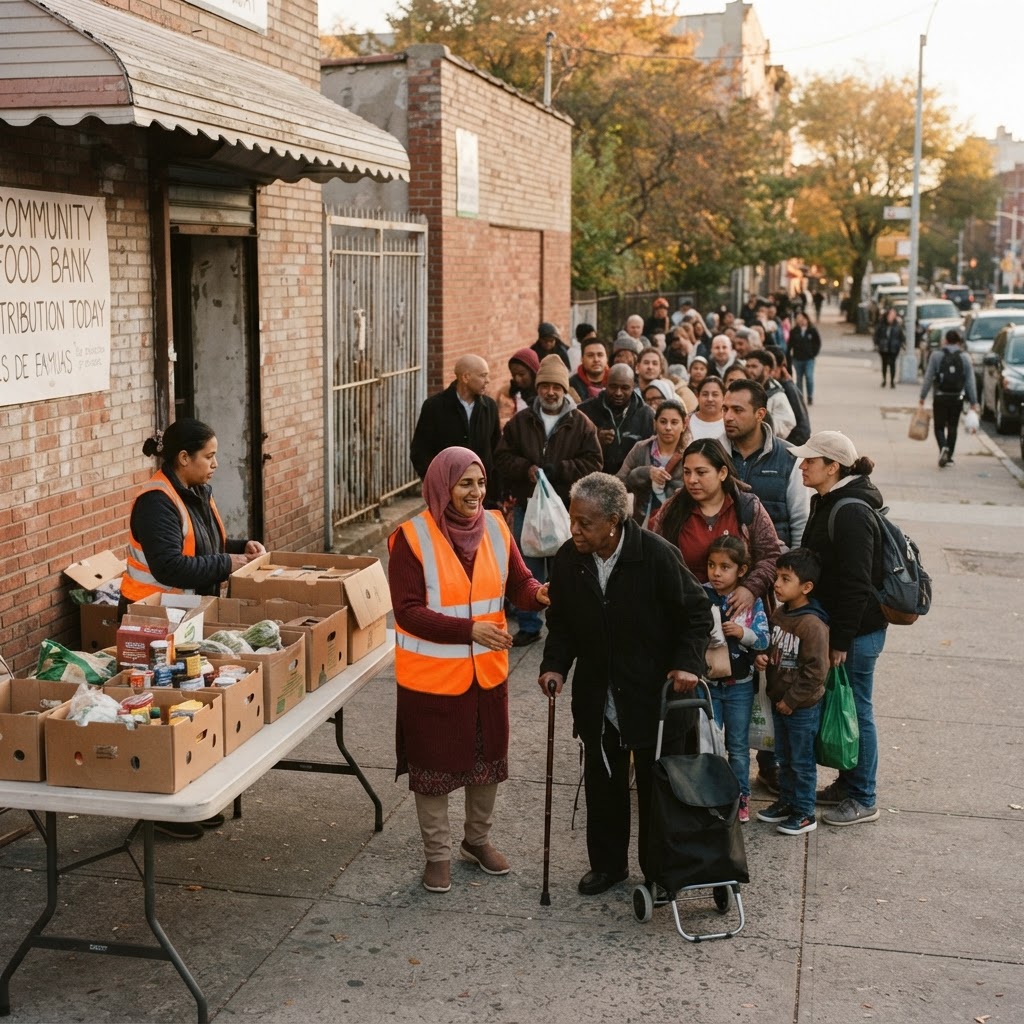
The Line That Wouldn't End: When the Safety Net Became the Only Net
SNAP benefits vanished overnight. The food network became the only net left, and it was never built to hold this much weight.
Duration
60 min
Difficulty
Advanced
Stakeholders
6
Company Size
Medium (100-500)
Educational Video
If the video doesn't load, it may be restricted by the uploader.
Open on YouTubeOrganizational Background
HungerBridge Community Food Network is a mid-size regional nonprofit operating a central warehouse, 14 partner distribution sites across the metro area, and a volunteer corps of roughly 400 active volunteers. For 12 years it has served as a reliable but modest player in the regional food assistance ecosystem, distributing approximately 2 million pounds of food annually to low-income families, seniors, and individuals experiencing food insecurity. Its annual operating budget is $4.2M, funded by a mix of individual donations, corporate gifts, foundation grants, and a federal commodity program (TEFAP). The organization has always operated within a larger system: SNAP (Supplemental Nutrition Assistance Program) served the vast majority of food-insecure households in the region, while HungerBridge filled gaps for those who fell through, faced emergencies, or lacked SNAP eligibility. The two were complementary. HungerBridge was designed as a supplement to the public safety net, not a replacement for it. Then the 2025 federal government shutdown hit. SNAP benefits were suspended indefinitely. Overnight, the population turning to HungerBridge tripled. The new arrivals included not only the 42 million Americans who normally rely on SNAP, but also furloughed federal workers, many of whom had never visited a food bank and were carrying shame, confusion, and urgency. Demand at distribution sites jumped 280% in the first week. Wait times stretched from 20 minutes to three hours. Warehouse inventory that normally cycled in 12 days was depleted in 72 hours. The organization is now caught in several interlocking system structures: 1. A reinforcing feedback loop: the demand surge depletes inventory and exhausts volunteers, which reduces service capacity and increases wait times, which generates media attention and public pressure, which drives leadership to launch emergency responses (extended hours, pop-up sites, emergency appeals), which draws even more people to HungerBridge, which further depletes resources. Each cycle tightens the spiral. 2. A shifting-the-burden structure: leadership has responded reactively with emergency distributions, emergency fundraising appeals, and emergency volunteer drives. These relieve the immediate symptom (people needing food today) but divert attention and resources from the fundamental problem (the organization was never designed to replace SNAP and cannot sustain this role). The more effective the emergency response, the more the organization becomes dependent on crisis mode, and the less capacity exists for structural redesign. 3. A tragedy-of-the-commons dynamic: HungerBridge's shared resources (warehouse space, refrigerated transport, volunteer hours, staff attention) are being consumed by each distribution site and each emergency initiative acting independently. No single site is doing anything wrong, but collectively they are depleting the commons faster than it can be replenished. There is no governance mechanism to allocate scarce resources across sites. 4. A fixes-that-fail pattern: to meet demand, HungerBridge pulled staff and volunteers from its nutrition education, advocacy, and capacity-building programs into emergency food distribution. This solved the immediate staffing gap but hollowed out the programs that were building long-term community resilience, and it triggered burnout and attrition among the very volunteers being asked to work double shifts. 5. The organization is an open system exchanging with its environment, but the environmental signals are contradictory: funders want to see emergency response numbers, media wants dramatic stories, partner agencies want their share of the food, service recipients want dignity and voice, and government is absent. Each signal pulls the organization in a different direction. Leadership responded within 48 hours of the shutdown with energy and commitment, but without conducting a systems analysis, without mapping interdependencies, and without engaging staff, volunteers, or service recipients in the redesign process. Three weeks in, the organization is functioning but fracturing: staff are burning out, volunteers are quitting at 15% per week, inventory is chronically short, partner agencies are competing for allocations, and the Executive Director is making decisions alone at 2 AM. The Board of Directors has engaged your team as OD consultants with systems thinking expertise. Your task is to diagnose where and why the system is breaking down, map the interdependencies using systems science tools, identify leverage points for systemic improvement, and propose participatory design methods that engage staff, volunteers, and service recipients in building a more adaptable and coordinated organization.
Key Stakeholders
Learning Objectives
- Apply systems thinking to diagnose an organizational mess by identifying the interlocking feedback loops, archetypes, and delays that produce system breakdowns under sudden environmental shock
- Map the reinforcing loop linking demand surge, resource depletion, reduced capacity, public pressure, and reactive emergency response that is accelerating HungerBridge's crisis
- Identify the shifting-the-burden and fixes-that-fail archetypes operating in HungerBridge's reactive response and explain why emergency interventions are undermining long-term capacity
- Analyze the tragedy-of-the-commons dynamic in the allocation of shared resources across 14 distribution sites and design governance mechanisms to prevent collective depletion
- Apply open systems theory to map HungerBridge's exchanges with its environment (funders, media, government, partner agencies, service recipients) and identify the contradictory signals pulling the organization in competing directions
- Identify leverage points for systemic improvement using systems science frameworks and prioritize interventions by their potential to change system behavior rather than merely relieve symptoms
- Design participatory, inclusive intervention strategies that engage staff, volunteers, and service recipients as co-designers rather than passive beneficiaries or implementers
- Analyze sociopolitical influences on organizational effectiveness, including the government shutdown, SNAP policy, racial and class dynamics in food assistance, and the political economy of nonprofit funding
Sign Up to Access This Scenario
Create a free account and get one free simulation to try PsychSim.
Host a Team Session
Click Host Team Simulation to create a session and receive a 6-character join code. Share the code with your teammates so they can join via Join Existing Session. At the end, a structured group debrief guide is generated for the team.
Instructor Monitoring
Instructors and admins have access to the Instructor Monitor in the sidebar. From there, you can view all live sessions, see the full conversation feed, send real-time notes to students, advance phases, and end sessions. To enable instructor access, an admin must set your account role to "instructor" in the User management section of the platform dashboard.